Thursday, January 13, 2011

Rethinking My Belt Kit

Back in September I did two posts on my belt kit. You can see them here as Part 1 and Part 2. There I went over the items that I carry on my belt in addition to my pack. They consisted of three main things, my knife, a possibles pouch, and a canteen kit.

Since that time however, I’ve started noticing that I do not always end up carrying my belt kit. Often times, I don’t want to go through the hassle of putting it on my belt, or just don’t want to have anything on my belt when I’m doing things like testing an axe. More often than not, the belt kit ends up in my backpack. While I feel very comfortable with the belt kit I described above, I have to be honest with myself. If it is not actually on my belt, it’s not much good.

As a result, I started to rethink my belt kit. I wanted something that is light and small enough that I could just put it in my pockets without it creating any noticeable bulk or weight (I didn’t want to look like a kangaroo, with my pockets swinging back and forth under the weight).

There are some things that I can’t do much about-I need my canteen. The only changes I have made to my canteen kit is that I have replaced the canteen with a Blackhawk canteen, and I have added a shoulder strap in case I don’t want to put it on my belt.

The rest of the kit looks like this.


The knife is small enough to fit in one of my pockets, and the possibles pouch stays in my other pocket. I keep the contents in an Adventure Medical Kits Ultralight 3 pouch. It is not completely full because I found that when I do that, it is bulkier than I want.

The knife is clearly a Mora No 1. It will probably get replaced when I find a puukko that I like, but for now it does quite well. I am looking for another knife that is under 8.5 inches and is light weight, probably meaning a puukko of some sort. Because the knife did not fit well within its sheath, I made it a new one. Remember, that I carry an axe with me. If I did not, I would not make this my only cutting tool. I feel much more secure with the Fallkniven S1, but I have to be realistic about how much I am willing to carry.


The contents of the possibles pouch is a downsized version of the one you saw before.


1. Plastic bag containing a commando saw and a compass. I keep the commando saw in the bad to protect the other items.

2. Set of water purification tablets.

3. Altoids Smalls tin containing tinder.

4. Altoids Smalls tin containing my fishing and repair kit. There I have fishing hooks and lures, line, thread and needle, and some duct tape.

5. Mini Bic lighter.

6. Waterproof and windproof matches with striker.

7. Artificial sinew.

8. Fenix E01 flashlight.

9. DC4 sharpening stone. I might end up replacing it with a DC3 in the future.

10. Plastic bag containing some pills. It is only first aid item left over from the prior possibles pouch.

11. Small ferrocerium rod.

12. Folded up plastic bag for water storage.

As you can see, the items are just downsized versions of what I had in my prior kit. The biggest thing that I have removed is my first aid items. It is not ideal, but they were adding too much bulk. What I have now is a kit that I ca easily put in my pockets and not notice that it is there until I need it.

As always, these are just items that I use and need. Your choices will certainly vary. If something else works for you, make sure to include it.

Wednesday, January 12, 2011

Historical Amnesia and the Manufacturing of History

A while back I did a post On the Quality of Cutting Tool. There I mentioned how sometimes we have a tendency to assume that some tool manufacturers possess what can almost be described as magical secrets. As I mentioned, I generally don’t believe that to be the case.

Often times I will hear people say that one tool must be better quality than another because one comes from a more respected or an older manufacturer. As such, they must know better how to make their cutting implement. Of course, there are variations in quality out there, but here I am specifically talking about thing such as the quality of the metal used in an axe head, or its edge retention being a result of “better” knowledge rather than market forces.

Specifically, I’ve heard comments like “an edge on a Gransfors Bruks axe will certainly outlast the edge of a hardware store axe if they had the same grind”. In my opinion, a statement like that is not based on factual analysis, but rather relies on the mystical reputation that the particular manufacturer has developed. After all, they have been making high quality axes for over a hundred years, they must know the perfect way to make an axe, right?

Well, if we actually start to examine history, we will quickly see that there is almost no truth to that belief. There is no doubt that Gransfors Bruks makes some of the finest axes out on the market today, but that is because of a lot of hard work and dedication put into the product by the current owners.

If we look back in time however, we will see that in 1985 Gransfors Bruks was bankrupt. We will also see that a Gransfors Bruks axe from that time period was identical to every other hardware store axe you will find today. You will also find that the “classical” axe designs which we covet today, were developed in 1989 by the new owner of the company, who had no prior experience with axes, after they did extensive research into the topic, much as we do. It is also a fact that similarly shaped axes by Wetterlings and Hults Bruk were put out on the market, after the new Gransfors Bruks designs showed selling power in the market.

My point is, don’t fall into the trap of thinking that because someone has been around for a while, or because they make a good product, that they have some magical secret that others know nothing about. There are certainly quality variations, but they most often result from market forces, not special knowledge. Judge each tool based on what it is and what it can do fo you. It may in fact turn out that the oldest or most expensive manufacturer makes the best product. However, make that call for yourself. Don’t just buy the hype.

Monday, January 10, 2011

Mechanized Axe Production Without the Use of a Drop Hammer

This is a video showing axe production at Wetterlings. It closely mimics the production method at the other Swedish axe manufacturers such as Gransfors Bruks and Hults Bruk.

Very often we refer to this process as hand forging, although that is not exactly correct. As can be seen from the video, the axe is made with an automated hammer and a set of dies through which the axe head is progressively taken. That is why you get such a consistent result for the same model head.

There is an even more automated method out there which uses a drop hammer. The main difference that I have seen is that a drop hammer requires less hits. It usually takes three to five hits with the drop hammer to produce the same result, again using a set of dies. Not all companies adopted the drop hammer method because of the high cost of the equipment.


The part that I found very interesting is that the video does not show the use of a lathe in making the handle. I have not looked at a Wetterlings handle closely, but I imagine one is used at some point.

To see an axe actually being hand forged, take a look at this video.

Sunday, January 9, 2011

Winchester Wood Hunter G-1340 Review

This knife is one of the first ones I ever used when I started spending time in the woods here in the US. It has proven to be a perfectly good knife, so I though I would review it here in case some people are looking for a non puukko style low cost knife.


Specifications:
Knife Length:
8 inches (203 mm)
Blade Length: 3 3/4 inches (95 mm); cutting edge 3 1/2 inches (89 mm)
Blade Thickness: 1/8 inches (3 mm)
Blade Width: 1 inch (25.4 mm)
Blade Material: Unknown stainless steel
Blade Hardness: Unknown
Type of Tang: Full
Blade Grind: Hollow ground with secondary bevel
Handle Material: Wood inlays
Sheath Material: Nylon
Cost: $13.00


This Winchester knife is the smallest one of several similarly looking knives made by the company. It costs about $13.00, and can often be found for much less. It certainly qualifies as a low cost knife in my book.

When the Winchester Wood Hunter G-1340 is compared to the Mora 1, it becomes clear that it is a very different knife design. It is a much more traditional hunting knife design, with a wider, more curved blade. The blade is almost twice as wide at that of the Mora 1, but its cutting edge is a bit shorter, coming in at 3.5 inches. The Winchester is hollow ground with a secondary bevel. The angle of the bevel is fairly narrow, although a bit wider than that of the Mora 1.


The Winchester Wood Hunter G-1340 is a full tang knife. The handle is created by placing part wooden and part metal scales on the sides of the tang. The handle is as short as that of the Mora 1, and is very narrow. It has very pronounced finger indentation. This makes the handle comfortable in certain positions, but not in others.

I was not able to find any information on the hardness or type of steel of the blade. That being said, it has proven to be quite usable. I have no idea how it will perform in a destruction test when compared to other knives, but I have used it for a long time without any problems. The steel is a bit soft, so you will have to touch it up, but I have never found that to be a problem.

I pulled the knife out of storage and put it through some basic tests.

The Winchester has a very wide and solid blade with a full tang. As such, it had no problem batoning through a 2-inch log.


There was also no problem with truncating. While the blade is strong, it is reasonably thin, making it easy to push through the wood.


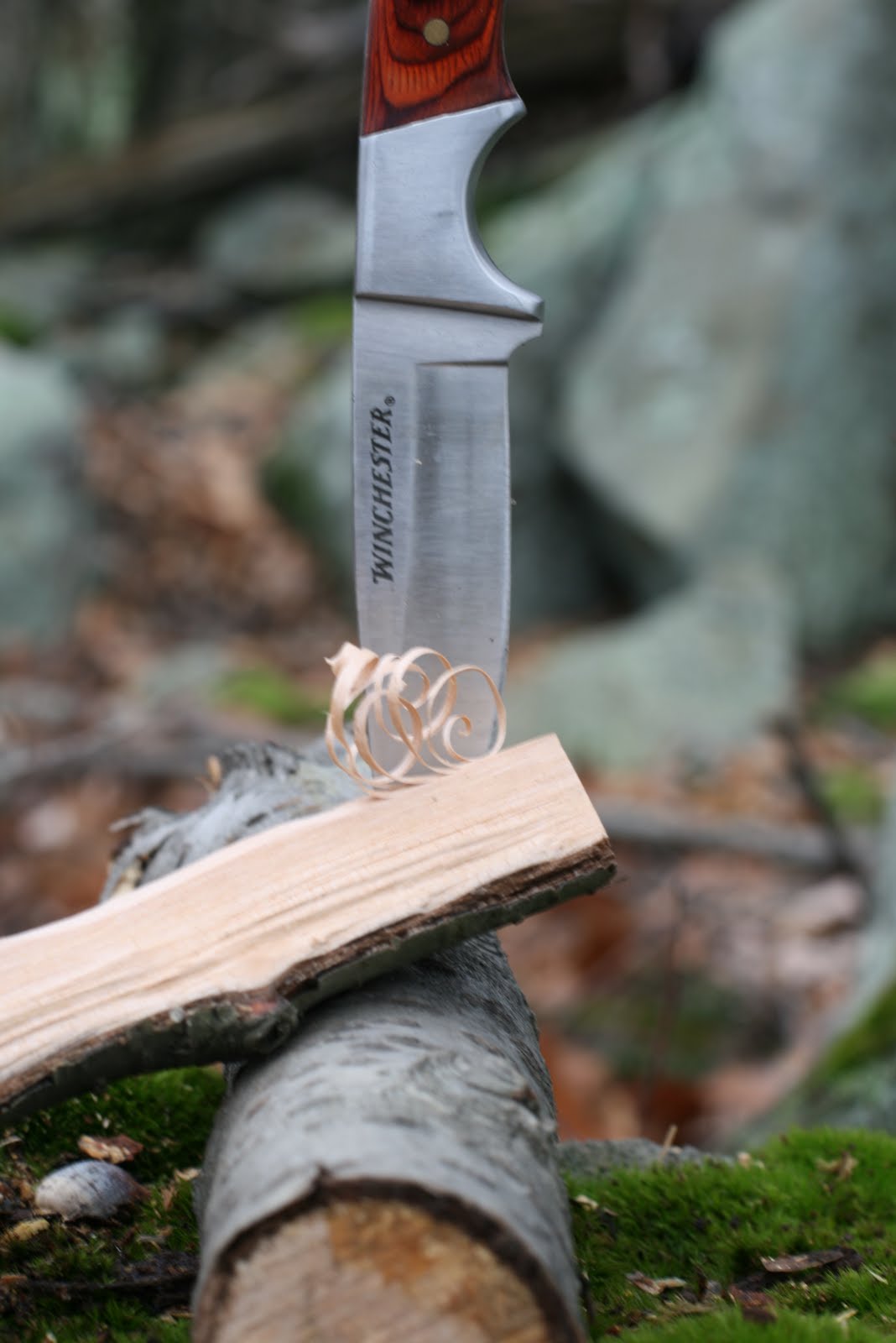
After that it was still sharp enough for some feather sticks. Like I always say, when it comes to feather sticks, the grind of the knife is not important. It all comes down to how sharp it is and how much practice you have.


Since this is a full tang knife, I drove the tip of the blade into a log by hitting the back of the handle. The knife had no problem, and did not show any damage.


The Winchester comes with an adequate sheath. It holds the knife securely, although there is some wiggle. It does not have a quick attachment loop, but other than that it is quite a solid, no-nonsense sheath.

The Winchester Wood Hunter G-1340 has always been a surprise to me. It is made in China out of unknown materials and comes at a very low price, but despite all that it is very well made and over a number of years has continued to perform without any problems. There are much more expensive knives with much lower quality. Its bigger brother was even used by Les Stroud on Survivorman during the last season.

I much prefer the Mora 1 from a design standpoint, as I am a big puukko fan. However, if you are looking for a different style knife at a low cost, the Winchester is certainly one that you should keep in mind.