Friday, September 21, 2012

Hultafors Might be Selling Axes in the US

For those of you who have been following the who Hultafors issue, you know that Hultafors has not been selling their axes in the US due to fears of litigation resulting from misuse of their axes. While the axes are being sold in Canada, sellers are currently being instructed not to ship to the US.

944[3]

Yesterday I got some news from Jason from Rocky Mountain Bushcraft, who informed me that Hultafors is currently considering entering the US market. If you want to express interest in their axes, and encourage the move, you can email Nils at nils.holmdahl@hultaforsgroup.com. Let’s see if we can bring these axes to the US market. The more choices we have, the better.

Wednesday, September 19, 2012

Trip Report: 9/16/12 – 9/17/12

Over the last few weeks I have been making some changes to my gear. In particular, I’ve changed two of my core gear items, my backpack and my shelter, in addition to changing some of the food that I carry. Theoretical discussions about gear are one thing, practical testing is another. So, before I undertook any more serious trip with these new items, I decided to do a short easy trip this past weekend to see how well they function and if any changes needed to be made.

I started out early in the morning in Harriman State Park. I figured I would do a loop that I had done before, so I knew the terrain, water sources, etc. There were some fast elevation changes, but no bushwhacking, so it would offer a good test for the new gear without creating serious problems if it didn’t work out as expected.

013-2

The new pack is the REI Flash 62. I originally bought it as my winter pack. It has a volume of 62L, which lets me fit all of my winter gear and food for about five days. I quickly figured out however that a lot of the volume was contained in the front and top pockets. The main compartment itself is about 50L. If I keep the front compartment empty, I can comfortably use the pack for my three season gear as well.

053

That’s exactly what I’ve decided to do, so this weekend I was testing the pack with the three season gear.

033-2

After some relatively steep climbing, I reached the rocky terrain above the tree line. Using a new pack was an interesting experience. It is a relatively light pack, coming in at exactly 3lb. This is the lightest internal frame 60+L pack I have been able to find. Even so, it has a very rigid frame. When the hip belt is well tightened, almost all of the weight is transferred the the hips. It made it easy to move through the steep terrain.
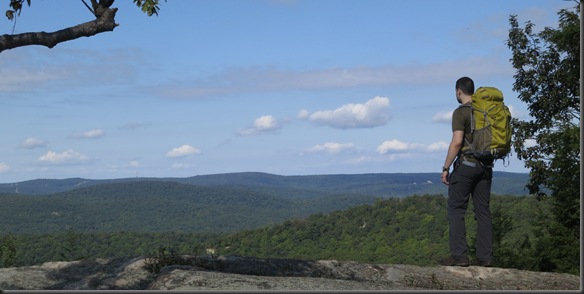
067-2

I continued traveling above the tree line for most of the day. At one point I moved down into the trees to get in the shade for some lunch.

088

I had made some changes to my food, in particular to the food I eat during the day. During the last few trips I had been getting tired of sweet food, and for some reason nuts, so for this one I decided to try more savory foods. I replaced the usual granola bars and chocolate with crackers, pepperoni and dried tomatoes.

091

I was very satisfied with this change in food. Maybe I was just getting bored with the old stuff. The food is also dense in calories. The amount you see in the above picture contain 1577 calories.

After lunch it was back above the tree line to continue my trip.
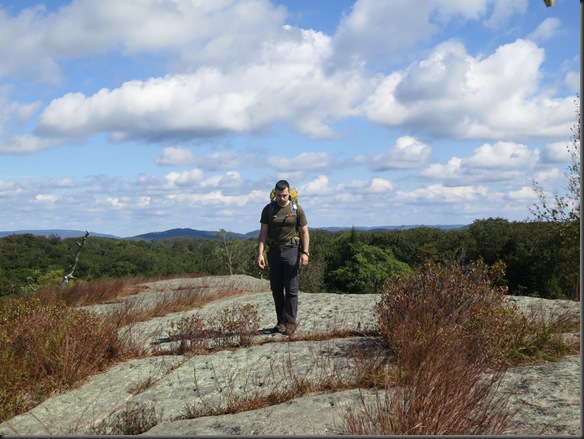
085

In late afternoon, I dipped back below the tree line in order to set up camp and take a closer look at the next piece of gear, the Go Lite Shangri-La 3.
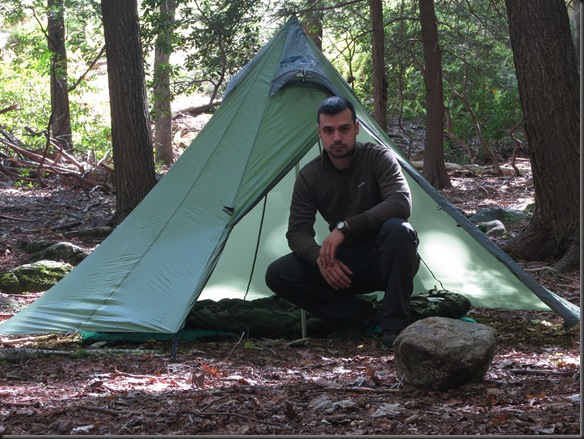
116

As some of you know, I have been using the larger Go Lite Shangri-La 5 for quite some time now. I have been very happy with the shelter. It is light weight, offers a lot of room, and allows you to work in it as you would under a tarp since it has no floor. The only issue I was having with it was that it required a large space to pitch. This was a particularly large issue when bushwhacking because I had a hard time finding large enough open spaces for the shelter. So, I decided to try the Shangri-La 3. It is the exact same design (well, it is a hexagonal rather rectangular shape) but has a much smaller foot print than the Shangri-La 5.

The shelter is accordingly noticeably smaller, but still large enough to function much in the same way as it’s larger brother the Shangri-La 5. After setting up the shelter, I lit the fire to cook some dinner.

167

For dinner I was trying out another food change. I have been eating a lot of mashed potatoes. They are easy to make and very calorie dense. I figured I would change it up a bit however, and try some stove top stuffing instead. It is just as easy to make (just add water), and is also calorie dense. The only down side is that it is bulkier to pack than mashed potatoes. I also added some chopped salami.

185

Now, this is one of those things that pops up when you are in the woods, that is easy to ignore when you are testing things at home. The food was great, but it left a lot of fat residue on the pot. It is something I didn’t think about when I was testing it at home, but it was an issue in the woods. I decided to use some ashes from the fire to clean it up. You know how they say that using ashes is as good as soap? Well, it’s not. It did however get the job done eventually. I unfortunately wasted more water in the cleaning process than I would have liked to.

After that, I called it a night. The shelter worked well. I’ll have to see how well it deals with sagging during heavy snow in winter, but I’ll have to wait a few months for that.

The next day I made breakfast and headed out. Nothing interesting to report. I did stop at one point to fill up with water.

190-2

As you may be able to see from the picture, I am using a 1L Platypus bottle for the filter. The 1L bottle that came with the filter developed a small leak on the last trip. Luckily, these Platypus bottles fit just fine with the filter.

After that, it was a short trek to the car. As expected, the trip was uneventful, and the new gear performed well. Here is the GPS record of the trip if for some reason you guys are interested.

1  

Well, nothing more to report. Now that the gear has had some preliminary tests, I’ll try a more challenging trip the next time out.

Monday, September 17, 2012

Three Favorite Items

Recently I was tagged by a fellow blogger at OutdoorEnvy to list my three favorite backpacking/bushcraft items. I’ve given the question a lot of thought. I like all of my gear, and I love using it. At the same time, I constantly keep changing and tinkering with my gear, so it’s hard to say which items are my favorite. The way I decided to resolve the issue is to pick the items that I love so much that I am unlikely to replace. These are the items that if I lost or damaged them, I would immediately try to buy another one, and if they are no longer in production, I would have looking for them on ebay. So, here are my three favorite items, listed in order of preference.

My top favorite item is my Salomon Quest 4D boots. I know, I know, we all want to see axes and knives, but the truth is that I will replace all of my other gear before I replace these boots. They just fit me perfectly. I had to try a lot of boots before I found these. In fact, I didn’t even know anything about them when I bought them. I simply put them on, and they fit so well, I had to get them.  

Boots

I’ve spared you the picture of my actual boots, which are now a few years old. I know there has been a trend in some parts of the community to move to lower height trail runners, but I stick to relatively high boots for one reason. It is not because of ankle support. I’ve never felt the need for it, nor do I think that a high boot will keep me from twisting my ankle. The reason is that it protects my toes when going down heel. By tightening the upper part of the boot, it keeps my toes from sliding forward into the boot, when moving fast down hill. It makes a huge difference in terms of comfort and mobility. The boots have a GoreTex lining. I know that there are also many people who dislike this feature, but I love it. It is true that when compared to unlined boots, if you get GoreTex lined boots wet on the inside, they will dry more slowly. However, in the most common circumstances, where you are going through mud or puddles, the lining keeps my feet dry and comfortable. With a pair of wool socks, I have had no moisture issues on the inside of the boots.

My second favorite item is my Open Country 2Qt pot. I don’t obsess too much about pots, but I know what I like when I see it. I’ve been using the Open Country 2Qt pot for quite some time now, and have been extremely happy with it. I’ve bought a spare one just in case they stop making them.

203  

It is a very cheap aluminum pot that most people don’t give a second thought when they see it in a store. It however has everything I look for in a pot. It weighs 7.7oz, and costs $11. It has a 2Qt capacity, which is the volume I prefer in a pot. While I can get away with a smaller pot, I like the extra volume so I can boil things like rice without worrying about overflow or splatter. It also has a wide base, which I find preferable for cooking both because of the added stability and the better heat distribution. It is a fairly thin pot, so initially I was worried about it getting damaged, but i have had it for over year now, and have not had a single issue with it.

My third favorite item is my Husqvarna hatchet. It is the older model that is no longer produced.

132

The hatchet has a 1.25lb head and a foot long handle. This is the hatchet/axe that I carry on most of my trips, and I find that it lets me do everything I need. I could replace it with other hatchets that will work just as well, but I just love the feel of this one.

Well, that’s it. They are not the most exciting items, but they are the ones I would not want to replace with anything else.

I’m tagging Akiri’s Blog, Gurthy’s Bushcraft, Perkele’s Blog for their favorite three items.

Wednesday, August 29, 2012

Backcountry Stoic Ti Kettle (700ml) Review

If you’ve been following my posts, you probably know that a few months back I decided to switch to a plastic cup instead of a metal one. Some of my reasons for switching were that it would be easier to handle when full of hot liquid, and would not freeze to my lips in winter. I’ve tried to use a kuksa style cup for some time now, and I just don’t feel as comfortable as I do with a metal cup. There is no good reason for it, I just miss having a metal cup. So, I decided to find one that I like. After some looking around, I chose the Backcountry Stoic Ti Kettle 700 ml. It used to be sold under just the name Backcountry Ti Kettle, so if you are looking online at older information, it is the same product.

053

The term “kettle” in the title is misleading. It is a 700 ml cup. As the name indicates, it is made out of titanium. The cup comes with a lid, which has strainer holes and a holder that locks upright. Everything comes in a well fitted mesh storage bag. The handles are of course folding, and are welded on, not riveted. I like that because it minimizes the chance of leaks developing. The Backcountry Stoic Ti Kettle nests perfectly on the bottom of a Nalgene bottle. It will also fit a 4oz SnowPeak or Jetboil fuel canisters, but not the wider MSR canisters.

094

The cup is very light, weighing by itself 3.1oz. Separate from that, the lid weighs 0.6oz, and the mesh holder another 0.4oz. Everything together weighs 4.1oz, although I personally only use the cup. The lid and stuff sack would be very useful if you used the cup for cooking, which I do not.

1493

I find the handles to be very comfortable, and I have no issues holding the cup just using the handles even when completely full. The small notch at the bottom of the handles works great to allow you to balance the cup. The handles also stay relatively cool when the cup is filled with hot liquid. The cup itself of course, gets very hot.

Overall, I am very happy with the cup. It is similar to the SnowPeak 700 and the Vargo Ti 700 mugs. I chose this one because it seemed to have simpler, more straight forward features. It ordinarily sells for $30-$40, but is currently on sale from Backcountry for $20.