Monday, January 14, 2013

Sir Ranulph Fiennes to Attempt a Winter Crossing of Antarctica

We have all read of the exploits of the early explorers of Antarctica like Shackleton, Scott and Amundsen. We have also see in more recent times people setting out to cross the frozen continent. All of those expeditions so far however have been done during the Antarctic summer. Sir Ranulph Fiennes, perhaps one of the greatest explorers has now set his sights on a winter crossing of the continent.

10723_Walltite_Antarctic

Fiennes is no stranger to the cold. He holds numerous records in the field of cold weather exploration, including the first unsupported crossing of Antarctica, as well as being the first person to cross both ice caps.

This new expedition will begin March 21, and is expected to last for six months. Since it will be done during the Antarctic winter, the journey will be done in complete darkness.

_62912752_trekingatnight

The plan is to have Fiennes and another individual traveling ahead of the team, pulling a sled carrying a ground penetrating radar. The radar will serve to detect any crevasses and other dangers under the ice. The two men will then be followed by a tractor that will pull the shelter and supplies. This huge amount of gear is necessitated by the cold, which could reach as low as –130F (-90C).

Ranulph-Fiennes-graphic-n-001

The expedition is extremely dangerous, not only because of the extreme temperatures, but also because of the impossibility of rescue. No airplanes or helicopters can fly in those conditions, so if the team is unable to proceed at any point, they would have to somehow  last out the winter before there can be any hope for rescue.

I think Sir Ranulph Fiennes is one of the finest examples of this unexplainable and admirable human characteristic which pushes great men to do great things just because they can.

Friday, January 11, 2013

“Stupid Simple” – Simplification of Gear as Means of Complicating the Outdoors

Before I get to the substance of the post, let me say that this is in no way intended to offend anyone or to designate any person as stupid. The title of the post is derived from a post written by another blogger, Andrew Skurka, titled “Stupid Light”. As a very general summary, the author, who is often referred to as an ultralight backpacker, at least by others, was expressing that there is a point where the preoccupation with lightening one’s gear can lead into gear selection that actually makes the trip more difficult, or even impossible, thereby negating the purpose of lightening one’s load to begin with. 

IMG_0336

Above picture: going “stupid simple” by not bringing a shelter. The wind was so strong that I had to gather a lot of firewood to offset the wind chill factor. I brought an axe that weighs almost as much as my shelter for that purpose. Stupid simple!

I would venture to guess that most of my readers are not preoccupied with cutting weight, especially if they find interest in traditional skills and bushcraft as I do. However, there is a similar concept in out circles that revolves around “simplification”, and “going back to basics”. With a zealous fervor we pursue minimizing our kit and the items we bring, much like the ultralight backpacking community obsesses over weight.

I certainly understand the desire, and benefit of reducing gear, just like I understand the desire to lower the weight of one’s gear. Having less items makes the ones you bring easier to use, makes you less reliant on gear, and teaches you how to efficiently use the resources around you. However, just like one can go “stupid light”, I believe one can go “stupid simple”. There comes a point where simplification loses its effectiveness, and in fact starts to counter the benefits it originally brought when we first started the simplification process.

To add to the dilemma, “traditional” gear and “multiuse” items also start to play a role in this “simplification” process. Often it is assumed that going back to the gear of our ancestors will simplify our kit and make our experience in the woods more basic. Similarly, there is the assumption that replacing two items with a single multiuse item is always a good idea, and simplifies one’s kit.

I think both of the assumptions are inaccurate, and if taken to extremes, can “simplify” our gear to a degree where it makes things more complicated. I have to admit, this type of stuff makes a lot more sense to me in my head than it does when I try to explain it, so let me try to do it through an example.

Let’s say that you are tired of carrying around a bulky sleeping bag. The solution? Bring a wool blanket. That way, you can leave home the sleeping bag as well as your coat, because the blanket can also be used as a coat when you wrap it around you. You have now removed two items from you kit, and replaced them with a single multiuse item. To top it off, it is a traditional item. Long live bushcraft! Right?

Well, not exactly. An item that theoretically has multiple uses is useless if you never actually use it or if it doesn't perform the jobs well. Let’s assume for this example that the blanket you are using is thick enough so that it offers the same amount of insulation/temperature rating as the sleeping bag. The odds are pretty good that this one blanket is actually heavier and bulkier that the down sleeping bag, down jacket, and hardshell jacket (because after all you now can’t use it over a wool blanket) that you just left at home. On top of that, as is the nature of multiuse items, it does not perform either function particularly well. Even if it keeps you warm at night, wrapping yourself in a blanket is a far cry from having a good jacket with you. Simple? Yes. “Stupid simple”? Looks like it. Replacing three one pound items with one five pound item that doesn’t perform any of the three jobs all that well, is one of those forms of “simplification” that actually makes things more complicated.

I know, the problem is that it is not simple enough! You decide to bring neither a blanket nor sleeping bag. You will just bring knowledge, which doesn’t weigh anything… and a full size axe. The forests will fall before your mighty swing, and the long fires will burn through the night and keep you toasty warm. Simplification! Tradition! Multiuse! Bushcraft!

Well, not exactly. The axe you brought has a 3.5lb head and a 1.5 lb handle, for a grand total of 5lb. For that weight you could have brought a 3lb sleeping bag (rated to 0F), a 1lb tarp, a 0.5lb stove, and a knife. Additionally, by “simplifying” you now have to spend several hours each day collecting fire wood. The simplicity that was supposed to free us when in the woods has now chained us down and is preventing us from traveling, looking for resources, or simply enjoying ourselves. Every hour you spend chopping wood for the night is an hour of fishing that has to be sacrificed, or two miles that have to fall short in your travels. Simple? You bet! “Stupid simple”? I think so!

Look, I think simplifying our gear is a great thing. Too often we see people in the woods relying all too much on huge amounts of gear. In effect they have brought their house out with them in the woods. I thin that misses the point, makes things potentially dangerous, and keeps one from truly enjoying the outdoors. However, when we take it to an extreme, we reach a point of “stupid simple”. This is exactly the same way that reducing the weight of your pack is a great idea. However, that process can easily lead to a place of “stupid light”.

Like Andrew Skurka put it: Not carrying what I need = “stupid light”. I would venture to say that a similar measuring stick can be applied to our urge to simplify.

Wednesday, January 9, 2013

Trip Report: Ice Climbing Day Trip 1/6/13

As you guys know, I usually don’t bother with doing trip reports for day trips, or other minor outings, but I figured I would share this one with you because it involves some of my gear that you guys have not seen before.

This past year I have been trying to expand my range of outdoor skills, so I can travel over more challenging terrain and be able to reach locations that otherwise would not be accessible to me. For me at least, that is a big part of woodsmanship. Feeling at home in the woods involves being able to travel through it and get to the resources you need over varieties of terrain and under different conditions. You have probably noticed that I have been working on my navigational skills, sometimes not very successfully. It has been with this theory in mind.

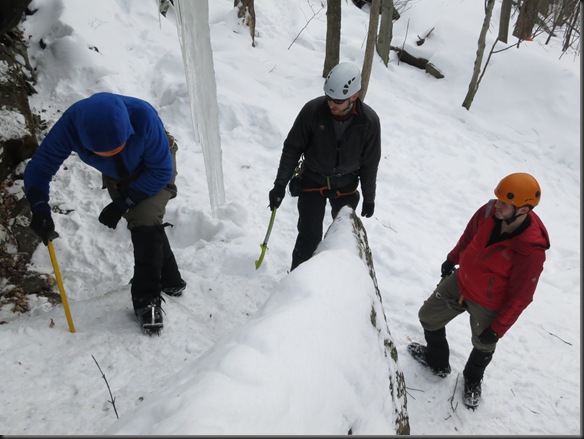
Over the past few years now, I have been working on what is very generally called mountaineering. Some of the skills involved include the proper use of different types of crampons, and ice axes, securing anchors, belaying, etc. Well, this Christmas, my girlfriend got me ice climbing lessons. By ice climbing I don’t just mean walking or ascending on ice, but rather the ability to climb vertically on ice. While I have a decent amount of experience (good or bad) traveling on moderately inclined ice, I had never done any actual ice climbing. So this past weekend I got together with two other guys, Dan and Jesse for the class. The course is run by Eastern Mountain Sports (EMS), which is actually the place where I buy all my mountaineering gear in my area. Eric (the guy in the white helmet was the instructor). He did an amazing job.

The meeting location was an equipment store for EMS near the Catskills. We got there early in the morning. The great thing about the course is that all the equipment is supplied if you need it. I already had mountaineering boots, crampons, and a general mountaineering (B rated) ice axe. The things I needed, and were provided to me were the harness, helmet, and ice tools (ice axes designed for technical ice climbing). After everyone got their gear, we went to the Kaaterskill region of the Catskills (coincidentally where I was for my last trip report), and started going up the mountain.

009

The instructor and I were wearing single mountaineering boots. I have the Scarpa Mont Blank GTX, which if you are interested in this type of stuff, are almost identical to the La Sportiva Nepal Evo GTX, but are about $100 cheaper. The other guys were using double plastic boots (an inner insulated boot covered by a plastic shell for rigidity and water protection). Understandably, some adjustments were required along the way in the hopes of achieving comfort.

042

NEW 027

Even so, getting to the ice wall was not particularly difficult.
037

NEW 030

It was about noon when we reached the location where we were going to start climbing. There was already another team there setting up. We stopped to eat lunch.

047

The ice axe you see under my helmet is my general mountaineering axe that I was talking about earlier. It is a Black Diamond Raven Pro. They come in different lengths. I have custom cut the shaft of this one to about 62 cm (ice axe lengths are measured in centimeters). For those of you not familiar, a general mountaineering axe typically has a straight shaft and is used over moderate terrain for support in the snow, cutting out steps in the ice or for self arrest if you fall. Such axes usually have a B rating. Technical axes on the other hand have a T rating (the shaft and head are rated separately), and are designed for more extreme angle ice climbing. In the pictures below you will see me using two of them to climb.

It is hard to see from the picture, but I was using my Black Diamond Sabretooth Crampons Pro. They are the ones I own, and are designed as a technical mountaineering crampon. They are not technical ice climbing crampons, but I wanted to use them here because I like them. They worked out just fine. The other guys were using the Black Diamond Cyborg Crampons.

049

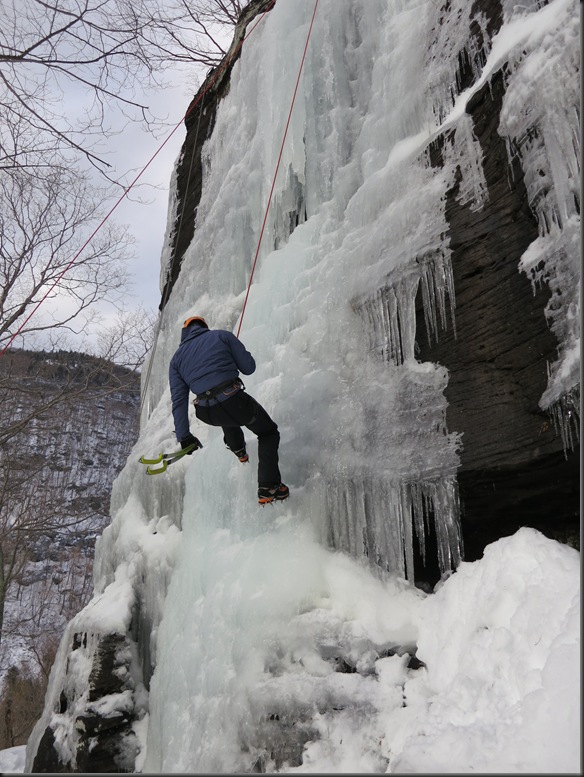
The day was very warm. It was about 26F (-3C). We started out with some easy ice, although, since I had never done it before, was the hardest part of the climbing for me. Here I am going up:

071

And coming down:

072

From there we moved to a harder location. By that time the temperature had suddenly dropped, so we had to add more layers. The ice was also wet in this location so I put on the hardshell top.

NEW 061

099

109 

 NEW 064

120

When I was on belay, I had to put on my Patagonia DAS parka. I was fine without it earlier in the day, but I was glad I had it in the later parts of the day. Its hood fits easily over a helmet, which makes a big difference.

NEW 072

Around 4:30 pm we took down the ropes, packed up and headed out.

142

Overall, a great day. The class was very useful, and in a very short amount of time, I was able to climb up grade 2 ice. I have no interest in sport climbing or becoming an ice climber, but it is a great tool to have in the bag, expanding the range of where I can go and what I can do when in the woods. I learned a lot that I can apply to my more general mountaineering. I also lucked out with having awesome guys in the class. Both Dan and Jesse were great to hang out with and as climbing partners, and Eric was an excellent instructor.

I was also very happy with my gear. When I bought the Scarpa Mont Blank boots, I never had ice climbing in mind. I got them as replacements for my plastic double boots because the double boots were just too uncomfortable for any significant travel. The Mont Blanks were very comfortable (for boots with a full shank) during the approach, which I knew from my prior trips, but they also performed extremely well when climbing. Similarly, my crampons, which I got for more general travel over ice, performed very well when I was climbing.

Monday, January 7, 2013

Dave Canterbury, Former Host of Dual Survival Apologizes to Fans

If you have been following Dual Survival, you no doubt noticed that in the new season, season three, one of the hosts, Dave Canterbuty, was replaced by Joseph Teti. In case you have a life, and have not been following the developing drama over the last few years, here is a brief summary:

dave-canterbury-dual-survival

Dave Canterbury, for those who remember him from the “early years”, started out as just another guy posting videos about his time in the woods on YouTube. At that time was not an expert on anything, he was just another person posting about his gear and ideas on camping (what has come to be known as bushcraft these days). He was a prolific poster, and his videos were, and still are very interesting.

At one point, the Discovery Channel decided that they wanted to make a wilderness survival show where they put together a no nonsense military vet (there is a presumption that military personnel have wilderness survival skills) and a tree hugging hippie, and watch the fun ensue. Dave Canterbury applied for the show, and got the job, giving him a two year contract on Dual Survival.

Almost immediately after that happened, many people who deem themselves bushcrafters got upset, after all, they also make YouTube videos, why was he picked for television and not them. People with a lot of free time started digging into Dave’s background, and some inconsistencies started to pop up. In particular, his military record seemed to be overly exaggerated. For example, on the early episodes of Dual Survival, it was claimed that he was a sniper. It turned out that he had done some sniper training, but was not an actual sniper.

Dave originally denied the allegations, and then stopped addressing them all together. When it was announced that he will not be returning for season three of Dual Survival, he released a statement that he was doing it so he can focus on his school. That became questionable after his former co-host, Cody Lundin, made some disparaging statements that you can read here.

Well, after the start of the new season, Dave Canterbury released a video, more or less admitting that he had exaggerated his military credentials in order to get the job on the show, and apologizes to his fans for doing so. By Dave’s request, the embedding option on the video has been removed, so I can’t show it here, but you can watch it here.